


Waystone — UK & Ireland · Heritage Guide

Waystone

Every place has a story.

A heritage guide for the United Kingdom and Ireland.
The map beneath your feet. The story in the ground.
The history that nobody thought to mention.

Indexing Castell HenllysIron Age · Pembrokeshire

54.0 N · 4.0 W iOS · 2026
How Waystone Works

Open the map. Read the place. Ask the guide.


9:41 ●●●●5G
Dolforwyn Castle
Castle · 13th C.
840 m NW
Explore →
View Ancient Ground
Filter Pins
Style: Storyteller
Ask Waystone
History, folklore, and local stories
Bookmarks
History

Dolforwyn Castle

Built c. 1273 by Llywelyn ap Gruffudd, the last native Prince of Wales. Its position on the ridge above the Severn was chosen for sightline, not convenience — the climb from the river is a punishment, even today.

“The coursed rubble is consistent with skilled Welsh masonry of the period — rare in a castle raised so quickly.”

It did not last. Edward I’s armies took it in April 1277. Records do not show the fate of the Welsh defenders.

Who held it after Llywelyn fell?
Edward I granted it to Roger Mortimer in 1279, with orders to rebuild. He never completed the work. The castle was effectively abandoned by 1322.
Anything still standing?
The keep’s northern wall, a stretch of curtain, and the round tower base. The chapel is reduced to footings.
Keep exploring
Who designed it?
What did the Welsh do with the body?
Ask about this place…
Why It’s Different

Most AI guides confidently invent the past.


Generic large language models do not actually know about the cropmark enclosure outside Pickering. Or the ruined chapel at Cwmrhaiadr. Or the Roman fort buried under a Lancashire estate. So they guess — confidently, fluently, in well-formed prose that reads like authority. The result is confabulation: invented dates, wrong attributions, half-remembered geography. For most British and Irish heritage — the obscure stuff, which is most of it — the failure rate is severe. This is why “AI heritage guide” remains a category that disappoints.

Waystone AI cannot say anything it hasn't read from our own curated historical library we call 'The Corpus' this grounds our AI in actual facts with citations.
TACKLING LLM HALLUCINATION

Underneath Waystone is a 2.8 million-passage heritage corpus, drawn from Historic England research reports, archaeological excavation reports, Cadw scheduled monument records, Coflein, the Royal Commission archives, antiquarian county histories, parish records, folklore collections, plaques, peer-reviewed archaeology journals, and hundreds of thousands of books. We have crafted our own retrieval system that finds every passage that actually mentions this site, this period, this place across our entire library. Waystone AI is constrained to describe what those passages say, and nothing else.

Waystone AI only serves to be the Librarian, not the expert. You ask a question or tap on a site and it retrieves every mention of that place or event and its only job is to summarise the passages it has read and weaves them together into an engaging narrative.

Generic AI
What can you tell me about Cwmrhaiadr?
Cwmrhaiadr is a picturesque medieval village in southern Wales, known for its 13th-century stone bridge over the Afon Wnion and a Norman church dedicated to St Cynog. The village features in the Mabinogion as a setting for several legendary tales.
No source. Mostly invented. Confidently.
A confident answer about a place that has no village, no bridge, and no Mabinogion entry. The model has never read about Cwmrhaiadr. It guesses.
Waystone
What can you tell me about Cwmrhaiadr?
Records describe a small upland holding above the Afon Dulas, the only surviving structure a 19th-century coursed-rubble barn of three-foot walls. Earlier occupation of the cwm is unrecorded. The name (Welsh, “valley of the waterfall”) appears on Ordnance Survey first edition (1888).
Coflein · NPRN 405123 — Cwmrhaiadr Barn
RCAHMW field survey, 1981
Ordnance Survey · 1st edition, Sheet 162 SE
Three retrieved passages. The model says only what they say. Where they end, it ends.
The Library

The largest aggregate of UK and Ireland heritage data of its kind.


Built from open and authoritative sources. Cross-referenced. Deduplicated. Indexed for retrieval. None of the data is invented. None of it is scraped from anywhere it shouldn’t be.

0
heritage sites across the UK and Ireland
0
indexed passages from authoritative sources
0
links connecting sites to the passages about them
0
archaeological features traced from aerial photography
0
open heritage datasets, all credited
Ancient Ground

See what the laser sees.


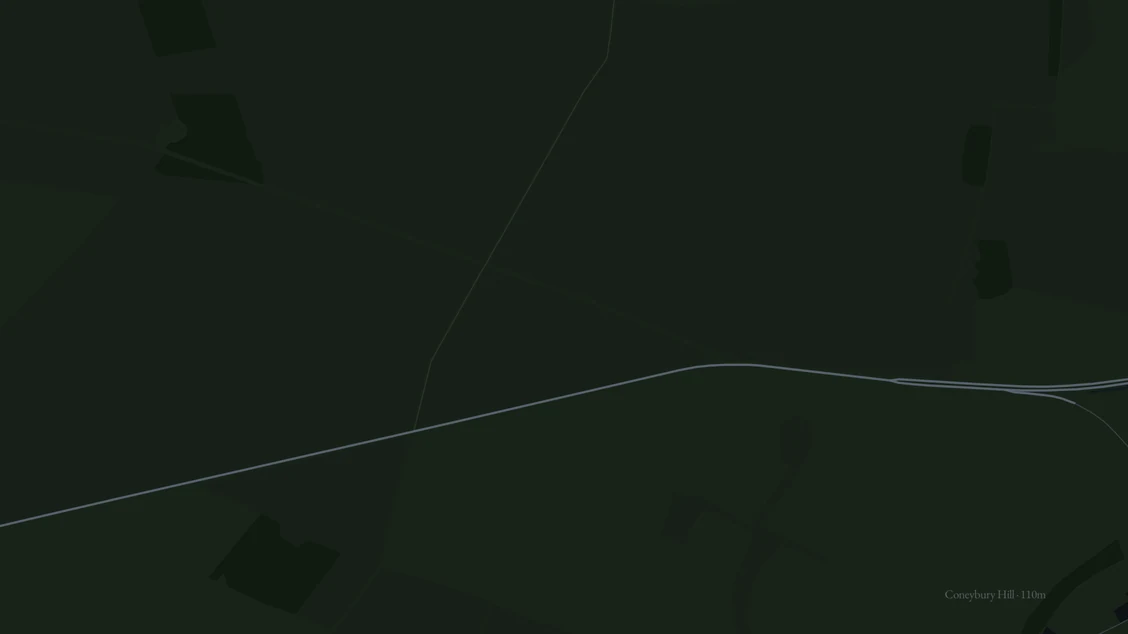
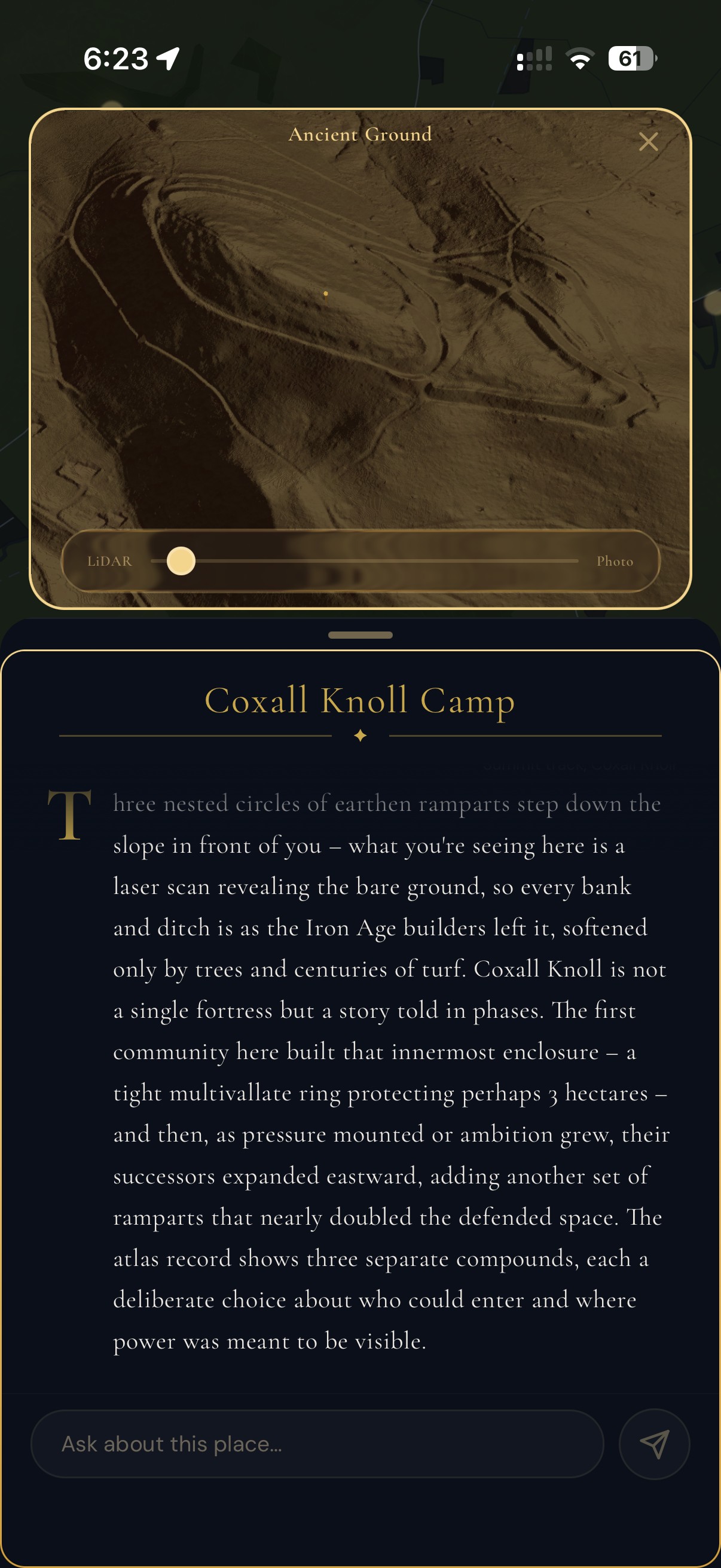
Beneath the soil of Britain and Ireland are field systems older than writing, settlements abandoned a thousand years ago, ritual landscapes that vanish at ground level. Modern eyes cannot see them. Satellite cameras cannot see them. The Environment Agency’s 1-metre LiDAR survey can — it sees the shape of the earth itself, bare of grass and tree and modern building. Waystone renders that survey into a 3D viewport at every eligible site, with a slider that blends between the laser view and aerial photography. See what your eyes see. Now see what the laser sees. The difference is 3,500 years of hidden history.

Ancient Ground
Hover a number to read what archaeologists see
LiDAR
Photo
Decoding Environment Agency LiDAR…
Hod Hill, Dorset · LiDAR @ z17 · 1-metre Environment Agency composite
Loading…

Loading…

The Invisible Map

Cropmarks. Earthworks. Things that only the sky has ever seen.


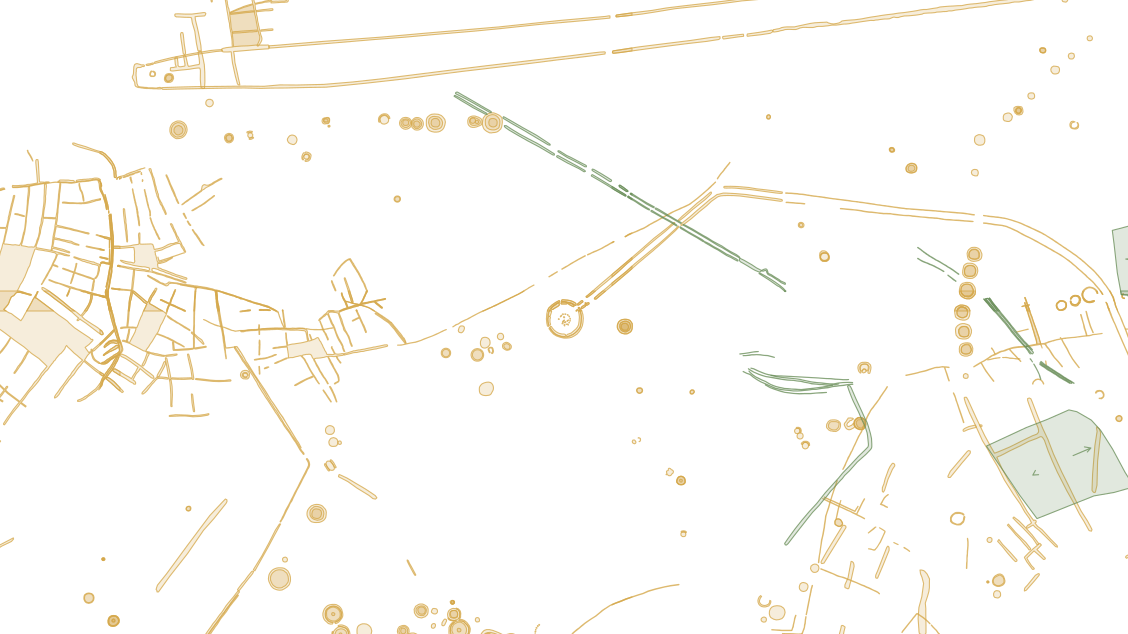
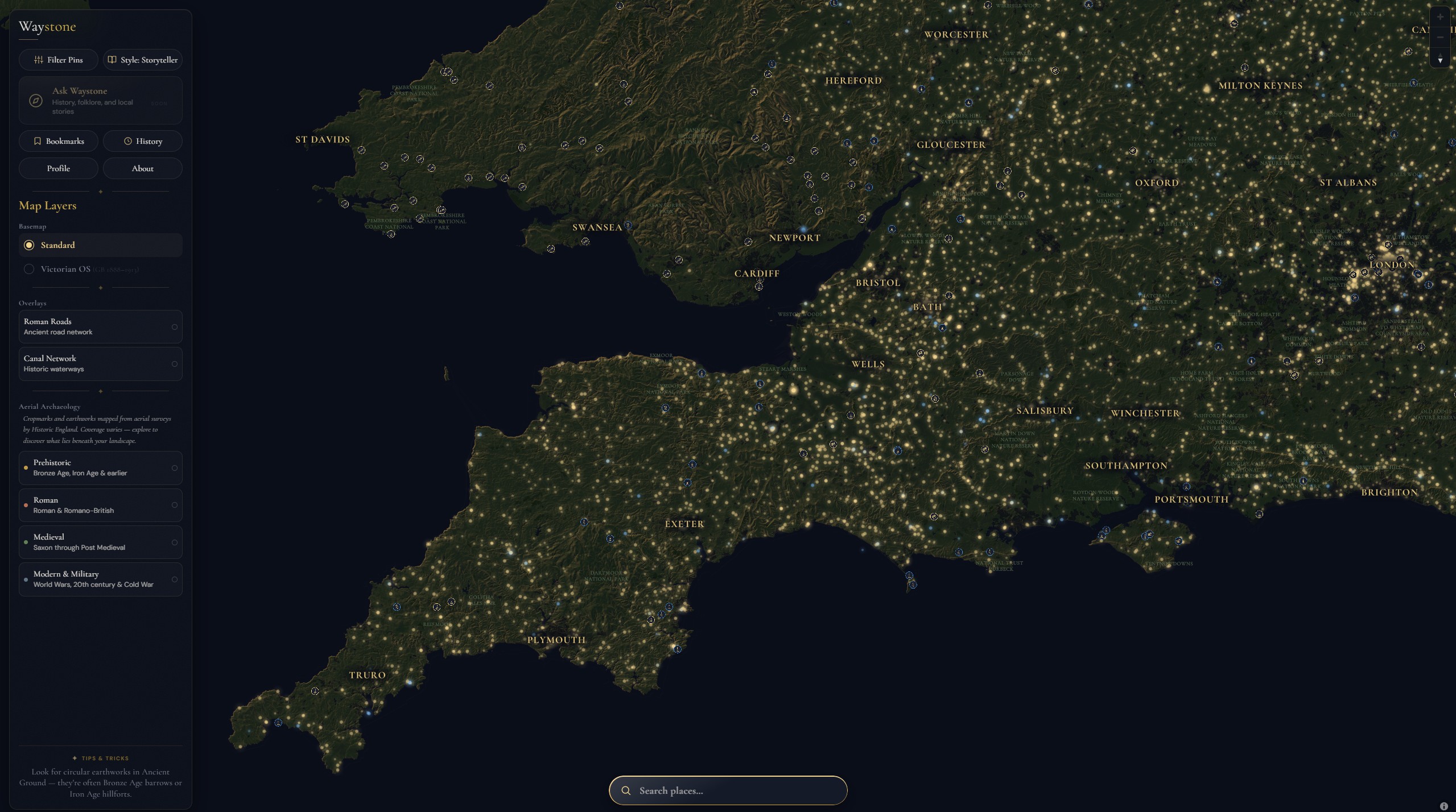
Historic England’s aerial archaeology programme has, over decades, traced 470,000 archaeological features visible from above — patterns in crop growth that reveal buried walls, soil discolouration that traces a Roman road, earthworks invisible at ground level. These are not designated heritage sites. Most have no monument, no signpost, no Wikipedia article. They are the invisible layer of the British landscape. Waystone overlays them onto the live map. A field that looks like any other field reveals itself as a buried Iron Age enclosure.

Live · 470,000 features
Loading aerial archaeology…
Salisbury Plain · Historic England AAME polygons rendered live from tiles.waystone-ai.org
The Voice

The same place. Four voices.


9:41 ●●●●5G

Cwmrhaiadr Barn

They built it to last. The walls are three feet thick in places — overkill for a barn, unless the weather up here had something to say about it. Whatever they kept inside, they meant to keep it. The roof has gone. The walls are going nowhere.

The narration register is yours. Set it once. Change it any time. The same site — a stone barn in the Welsh uplands — described in each of Waystone’s four voices. Tap one.

Real narrations. Generated by Waystone from retrieved sources.
The Maker

A passion project.


Waystone is made by Matt Bramhall — a single person, in the UK, with an unreasonable interest in what is under your feet. There is no team. There is no funding. There are no investors. The product is whatever the product needs to be.

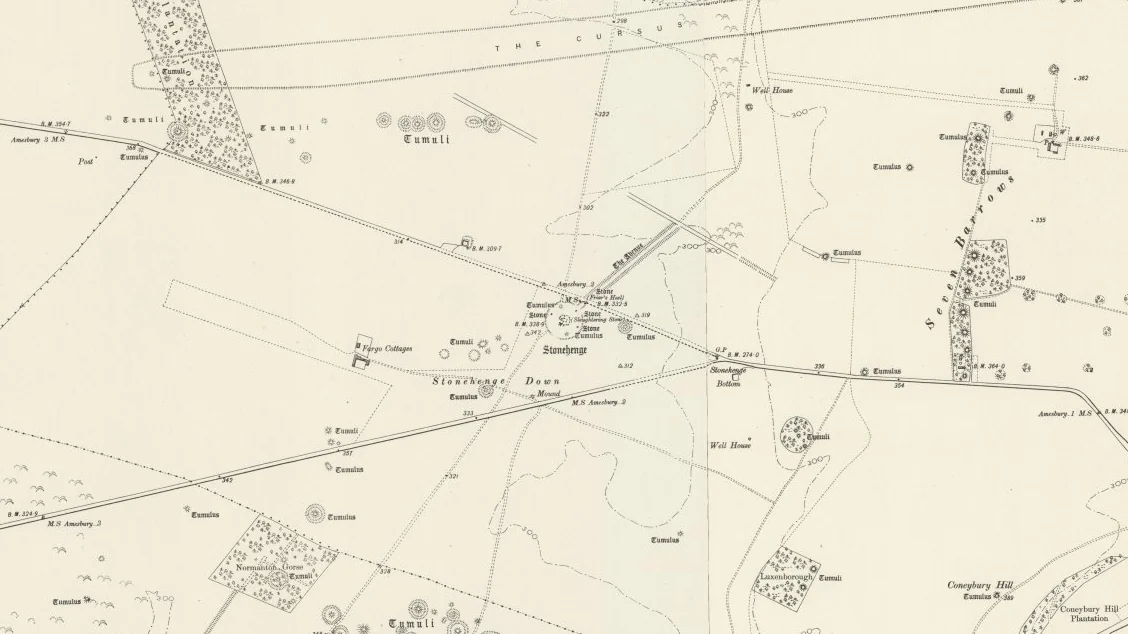
Research collaboration with Chris Fleet, Senior Map Curator at the National Library of Scotland — extending Waystone’s data extraction pipeline to historical Ordnance Survey maps. The font typography of Victorian-era OS maps encodes the period of every feature on the page. Recovering that encoding is its own small archaeology.

Begin

Open the map. See what’s underneath.

Eight hundred thousand sites. Twenty-eight datasets. One quiet guide. The web viewer arrives soon — step inside.

Beta preview · iOS app arriving 2026
Researchers & the curious
Read the sources, not the summary.
Search the corpus →